

DSTA: Disaster Relief VR Training
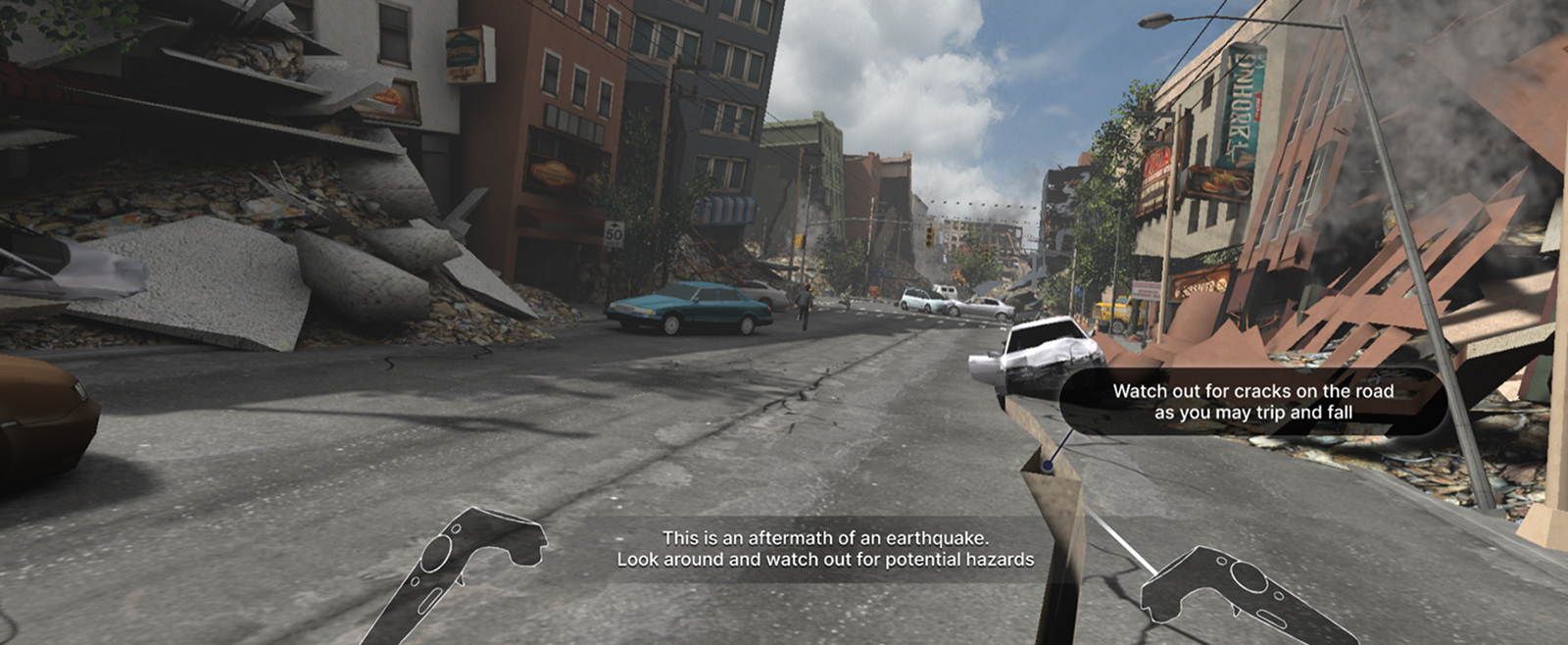
For DSTA, we designed and built an end-to-end VR training platform aimed at preparing military cadets for the realities of disaster relief operations before they ever step foot in one. Rather than throwing cadets into photorealistic chaos from the start, the experience is intentionally designed as a first point of entry: a semi-realistic, immersive environment across three disaster scenarios (flood, earthquake, and urban collapse) where the goal is gradual acclimatisation.
The sheer scale of each scene, contrasted against the cadet as a single individual, communicates what no classroom briefing can. Alongside environmental exposure, cadets navigate reflective decision-making tasks that build early situational awareness. Fully conceived and built in-house from concept through UX and UI, the platform has since been rolled out and well received by DSTA.
Multi-Scenario VR Environment
Three distinct disaster scenarios built for the Oculus 2 headset: flood, earthquake, and urban collapse. Each environment is crafted in 3D at a scale that conveys the enormity of real-world disaster conditions, designed as a deliberate stepping stone toward more intense, photorealistic training that follows. The semi-realistic aesthetic is intentional: this is where acclimatisation begins, not where it ends.
Trainer Command Platform
A custom-built tablet interface gives trainers full oversight of up to 10 cadet headsets simultaneously. Trainers can select and switch scenarios, pause, rewind, trigger in-scene events, and monitor cadet progress in real time through screencasting, keeping full control of the session without ever disrupting the cadet's immersion.
Two-Way Communication System
Despite running as independent sessions, every cadet remains connected to the trainer through a live two-way communication layer. Cadets can call on the trainer from within the VR environment, and trainers can respond or intervene directly, enabling real-time guidance, structured evaluation, and meaningful debrief at the close of each session.
Client
Defence Science and Technology Agency
Year
2025